What is a Drilling Mud Shear Pump?
Aug 14, 2025
A drilling mud shear pump is a high-shear mixing device specifically designed for drilling mud treatment. It crushes and disperses solid particles in the mud through mechanical forces (shearing, impact, and turbulence) while promoting the full dissolution of additives such as polymers and clays. Ultimately, it achieves mud homogenization, rheological optimization, and performance enhancement.
Ⅰ. Core Functions
Crush large solid particles in the mud (e.g., cuttings, undispersed clay) to reduce particle agglomeration.
Accelerate the dissolution and activation of chemical additives such as polymers, fluid loss reducers, and viscosifiers.
Improve the viscosity, shear force, and rheological properties of the mud, enhancing its ability to suspend cuttings, inhibit wellbore collapse, and cool the drill bit.
Maintain the stability of the mud system, ensuring efficient cuttings carrying, well pressure balancing, and drill string lubrication during circulation.
Ⅱ. Working Principle
The core principle of a drilling mud shear pump lies in generating intense shear forces and hydrodynamic effects through the high-speed relative motion between the rotor and stator. The specific process is as follows:
1.Shearing Action: A small gap (shear gap, typically 0.1–1mm) exists between the rotor (high-speed rotating component) and the stator (fixed component). As mud passes through this gap, it is "sheared" by the high-speed rotating rotor, tearing large particles into smaller ones.
2.Impact and Turbulence: The high-speed rotation of the rotor blades drives the mud to generate intense turbulence and vortices. High-frequency impacts occur between particles and between particles and blades, further crushing particles and dispersing additives.
3.Mixing and Homogenization: Under the combined effect of shearing and turbulence, solid particles, liquids, and additives in the mud are fully mixed, forming a uniform and stable system to prevent stratification or sedimentation.
Ⅲ. Structural Composition
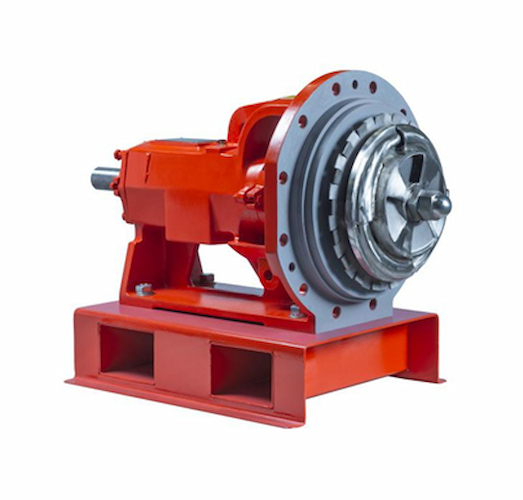
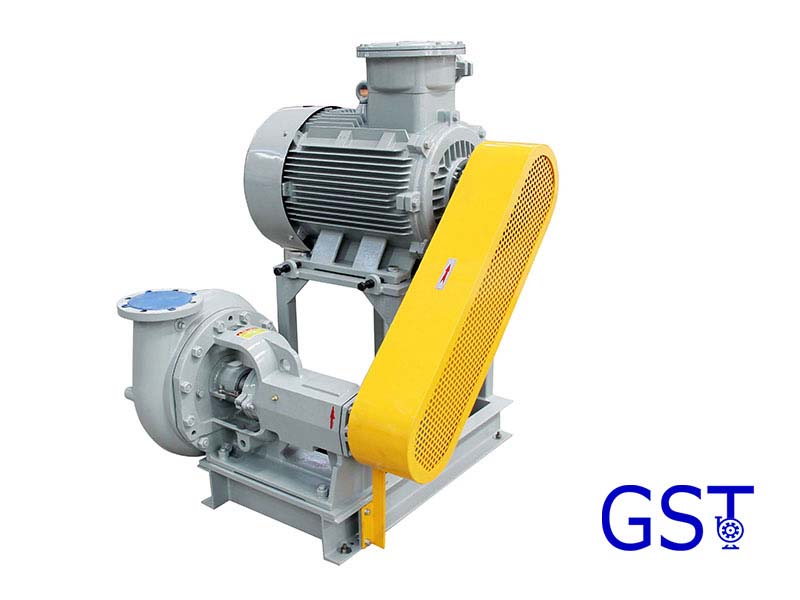
The structure of a drilling mud shear pump is designed to meet requirements such as high shear efficiency, wear resistance, and adaptation to harsh working conditions. It mainly consists of the following components:
1. Power Drive System
Drive Source: Typically an explosion-proof motor (for onshore drilling) or a hydraulic motor (for offshore drilling, adapted to high-vibration environments), providing rotational power. The power range varies from tens to hundreds of kilowatts, matched according to processing capacity.
Reduction/Transmission Device: Transmits power to the rotor through couplings, gearboxes, etc., and adjusts the rotor speed (usually 1000–3000rpm; higher speeds improve shear efficiency).
2. Core Working Components: Rotor and Stator
Rotor: The "active component" of the shear pump, mostly cylindrical with spiral blades or tooth-like protrusions on its surface. Blade materials must be wear-resistant (e.g., high-chromium cast iron, tungsten carbide coating) to withstand scouring by hard particles in the mud.
Stator: The "passive component," fixed in the pump housing and coaxially assembled with the rotor. Its inner wall is designed with grooves or channels matching the rotor blades. The gap between the rotor and stator can be controlled by adjusting structural parameters; a smaller gap enhances shear force (but risks blockage must be avoided).
3. Fluid Channel System
Inlet: Connected to mud tanks or circulation pipelines, through which mud is drawn into the shear chamber by pump suction or external force.
Shear Chamber: The space between the rotor and stator, serving as the core area where mud undergoes shearing and impact.
Outlet: Through which the treated homogenized mud is discharged, returning to the circulation system or proceeding to the next processing step.
Flow Guide Structure: Some shear pumps are equipped with built-in guide plates or spiral channels to guide axial mud flow, avoiding local stagnation and improving mixing uniformity.
4. Auxiliary and Protection Systems
Sealing Device: Uses mechanical seals or packing seals to prevent mud leakage (especially under high pressure) and protect the drive system from mud contamination.
Cooling System: For high-power pumps, water cooling or air cooling reduces the operating temperature of the rotor and stator, preventing material aging caused by frictional heat.
5. Control System
Equipped with frequency converters, pressure sensors, flow meters, etc., it can real-time adjust speed, monitor inlet/outlet pressure and flow, and adapt to the processing needs of different mud types (e.g., water-based mud, oil-based mud).
Ⅳ. Core Technical Features
High Shear Efficiency: By optimizing rotor and stator structures (e.g., multi-group tooth engagement, stepped shear gaps), particle refinement efficiency exceeds 90%, and additive dispersion speed is increased by 30%–50%.
Wear-Resistant Design: Key components use wear-resistant alloys (e.g., Cr12MoV), rubber linings, or ceramic coatings to extend service life (in abrasive formation drilling, service life can be 2–3 times that of traditional pumps).
Strong Adaptability: Capable of handling high-viscosity, high-sand-content mud (sand content ≤15%) and compatible with water-based, oil-based, and synthetic-based muds.
Stable Continuous Operation: Designed for continuous working mode with a wide processing flow range (10m³/h to 500m³/h), meeting the needs of different drilling scales (e.g., shallow wells, deep wells, horizontal wells).
Ⅴ. Application Scenarios and Importance
Drilling mud shear pumps are widely used in oil and gas drilling, shale gas development, geological exploration, etc., with specific scenarios including:
1. Drilling Mud Preparation Stage
In mud tanks, shear pumps mix bentonite, clay, and other base materials with water, while adding polymers (e.g., polyacrylamide), fluid loss reducers (e.g., CMC), and other additives. Shearing ensures full dissolution of additives, avoiding undissolved polymer lumps, and provides qualified initial mud for drilling.
2. Drilling Circulation Process
During drilling, returned mud carries a large amount of cuttings and drill debris. Shear pumps can crush large cuttings to prevent sedimentation in mud tanks; when 补充添加剂,shearing quickly restores mud viscosity and suspension capacity, maintaining stable circulation.
3. Regeneration of Degraded Mud
For mud with degraded performance due to long-term circulation (e.g., reduced viscosity, poor suspension), shear pumps can re-disperse particles and reactivate additives through re-shearing, realizing mud regeneration, reducing waste discharge, and lowering new mud preparation costs.
4. Special Drilling Technology Requirements
In complex well types such as directional wells and horizontal wells, higher rheological requirements are imposed on mud (e.g., low viscosity, high cuttings carrying capacity). Shear pumps can optimize mud rheological parameters by precisely controlling shear intensity, ensuring wellbore trajectory control and cuttings carrying efficiency.
Ⅵ. Selection and Maintenance Guidelines
1. Key Selection Parameters
Processing Flow Rate: Determined by drilling fluid circulation volume, usually 1.2–1.5 times the drilling pump displacement.
Shear Intensity: Select rotor-stator structures based on mud type (e.g., high shear for finely dispersed mud, strong crushing for coarse-particle mud).
Working Pressure: Adapt to mud circulation system pressure (typically 0.5–2MPa) to avoid overload.
Corrosion Resistance: For oil-based mud or chemically additive-containing mud, acid- and alkali-resistant materials (e.g., 316 stainless steel) are required.
2. Daily Maintenance Focus
Regularly inspect rotor and stator wear; replace when the gap exceeds 50% of the initial value to prevent reduced shear efficiency.
Clean the inlet filter to prevent blockage or component damage caused by large impurities entering the shear chamber.
Check for leaks in sealing devices and replace seals promptly to protect the drive system.
Regularly lubricate transmission components to ensure stable operation and reduce energy consumption.
Ⅶ. Conclusion
Drilling mud shear pumps achieve mud homogenization and performance optimization through high shear forces, serving as core equipment connecting mud preparation, circulation, and regeneration. Their advanced design, rational selection, and standardized maintenance directly affect drilling efficiency, wellbore safety, and cost control. As oil and gas exploration advances to deep and complex formations, efficient, wear-resistant, and intelligent shear pump technology will become a key support for enhancing the competitiveness of drilling engineering.
Read More



 Language :
 English
 Русский
 عربي
عربي
 GET A QUOTE


 IPv6 network supported