What is a rotary system in drilling?
Apr 09, 2025
The rotary system of drilling equipment enables the drill string and the drill bit to rotate, thereby penetrating the earth's strata and drilling a wellbore. It is mainly composed of the rotary table, top drive device, drill string, drill bit, and related control systems. The following is a detailed introduction for you:
Ⅰ. Main Components
Power Source: It provides power for the rotary system. Commonly used ones are diesel engines and electric motors. Large-scale drilling platforms may use multiple diesel engines or electric motors working jointly to meet the power demands of different drilling conditions.
Transmission Device: It includes gear transmission, chain transmission, hydraulic transmission and other devices. Its function is to transmit the power of the power source to the drill string, so that the drill string drives the drill bit to rotate. For example, in the rotary table rotary system, the power is transmitted from the power source to the rotary table through gear transmission, and then the rotary table drives the kelly to rotate; in the top drive system, the power is directly transmitted to the top drive device at the top of the drill string through hydraulic or electrical transmission devices.
Drill String: It is composed of drill pipes, drill collars, etc., and is an important component connecting the drill bit and surface equipment. It transmits the rotational power from the surface to the drill bit at the bottom of the well. At the same time, during the drilling process, it also plays the roles of conveying the drilling fluid and supporting the drill bit.
Drill Bit: It is a tool that directly acts on the rock. According to different geological conditions and drilling requirements, there are various types, such as roller cone bits, PDC (Polycrystalline Diamond Compact) bits, etc. The drill bit, through various cutting structures, rotates and cuts the rock under the drive of the drill string to form a wellbore.
Ⅱ. Rotary Table
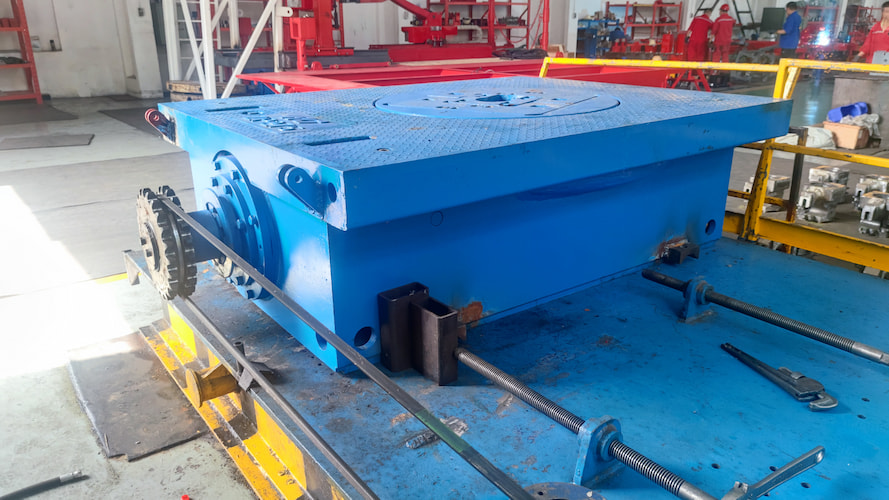
Structure: It is mainly composed of a driving device, a turntable, a main bearing, a sprocket, a braking device, etc. The driving device generally uses an electric motor or a hydraulic motor, and transmits the power to the turntable through the sprocket and chain. The main bearing supports the turntable to enable it to rotate smoothly. The braking device is used to stop the rotation of the turntable when necessary.
Working Principle: The driving device provides power, drives the turntable to rotate through the sprocket and chain. There are square bushings on the turntable, and the kelly is inserted into the square bushings. As the turntable rotates, the kelly drives the drill string and the drill bit to rotate together, thus achieving the purpose of breaking the rock.
Application Scenarios: It is widely used in various types of onshore and offshore drilling platforms. It is a commonly used rotary component in traditional drilling equipment, especially showing good applicability in the drilling operations of some shallow and medium-deep wells.
Ⅲ. Top Drive Device
Structure: It is usually composed of a drilling rotary swivel, an electric motor, a gearbox, a main shaft, a balance system, etc. The swivel provides a passage for high-pressure drilling fluid for the drill string. The electric motor serves as the power source, and transmits the power to the main shaft through the gearbox, and the main shaft drives the drill string to rotate. The balance system is used to balance the weight of the top drive device and reduce the load on the derrick.
Working Principle: The electric motor drives the gearbox, and the output shaft of the gearbox is connected to the main shaft, driving the main shaft to rotate, and then driving the drill string and the drill bit connected below the main shaft to rotate. At the same time, the drilling fluid enters the inside of the drill string through the swivel and is ejected from the drill bit, realizing the circulation and cuttings-carrying functions of the drilling fluid.
Application Scenarios: It is widely used in the drilling operations of deep wells, ultra-deep wells and complex formations. It can improve the drilling efficiency and reduce the time for making up drill pipes. It is especially suitable for situations where frequent tripping of the drill string and control of complex wellbore trajectories are required.
Ⅳ. Drill String
Structure: It is mainly composed of drill pipes, drill collars, heavy-weight drill pipes, etc. The drill pipe is the main component of the drill string, usually made of high-strength steel pipes, and is used to connect the drill bit and the wellhead equipment, transmitting torque and drilling fluid. The drill collar is located at the lower part of the drill string, close to the drill bit. It has a relatively large weight and is used to apply the drilling pressure to the drill bit to ensure that the drill bit can effectively break the rock. The heavy-weight drill pipe is used between the drill pipe and the drill collar to adjust the weight and stiffness of the drill string.
Working Principle: In the rotary system, the drill string rotates with the rotation of the rotary table or the top drive, transmitting the torque from the wellhead to the drill bit, enabling the drill bit to cut the rock. At the same time, the inside of the drill string is the passage for the drilling fluid. The drilling fluid flows downward from the inside of the drill string under the action of the pump, and after being ejected from the drill bit, it carries the cuttings back to the wellhead.
Application Scenarios: It is applicable to various drilling operation environments. Drill strings are indispensable for drilling operations from shallow wells to deep wells, and from onshore to offshore drilling platforms. Different well depths, formation conditions and drilling process requirements will require the selection of drill strings of different specifications and materials.
Ⅴ. Drill Bit
Structure: The structure varies according to different types. A common roller cone bit is composed of cones, legs, bearings, etc. There are teeth on the cones, and the rock is cut through the rolling of the cones and the breaking action of the teeth. The PDC bit uses diamond compact slices as cutting elements, which are fixed on the bit body.
Working Principle: During the rotation of the roller cone bit, the cones roll and come into contact with the rock surface, and the teeth produce impact and extrusion effects on the rock, causing the rock to break. The PDC bit relies on the high hardness and wear resistance of the diamond compact slices to break the rock by cutting, and has a relatively high drilling efficiency.
Application Scenarios: The roller cone bit is suitable for various hardness formations, especially performing well in hard formations and abrasive formations. The PDC bit has obvious advantages in soft to medium-hard formations and can achieve rapid drilling.
Ⅵ. Control System of the Rotary System
Structure: It includes an operation control console, sensors, a controller, etc. The operation control console is the interface for operators to control the rotary system. It is equipped with various buttons, knobs and a display screen, which are used to set parameters such as the rotation speed and torque. Sensors are distributed in various key parts of the rotary system, such as the electric motor, gearbox, drill string, etc., and are used to monitor the running status of the system in real time, such as the rotation speed, torque, temperature, etc. The controller precisely controls each component of the rotary system according to the settings of the operator and the information fed back by the sensors.
Working Principle: The operator sets the working parameters of the rotary system through the operation control console. The controller, according to these set values and the actual operation data fed back by the sensors, adjusts the rotation speed of the electric motor, controls the start and stop of the braking device, etc., so that the rotary system operates in the set working state. For example, when the sensor detects that the torque of the drill string is too large, the controller will automatically reduce the rotation speed of the electric motor to prevent the drill string from being damaged due to overload.
Application Scenarios: In various drilling operations, the control system plays a vital role. It can ensure the safe and efficient operation of the rotary system and adapt to different drilling process requirements and changes in formation conditions.
Ⅶ. Common Faults and Solutions of the Rotary System of Drilling Equipment are as follows:
Faults of the Rotary Table
The rotary table rotates inflexibly or there is a jamming phenomenon
Reasons: The main bearing of the rotary table is worn or damaged, resulting in an increase in the rotation resistance; the chain is too tight or the sprocket is worn, affecting the power transmission; there is foreign matter stuck between the turntable and the base; the clearance between the square bushing and the kelly is too small or the wear is uneven.
Solutions: Check the main bearing, and replace it in time if it is worn or damaged; adjust the tightness of the chain, check the wear condition of the sprocket, and replace the sprocket if necessary; clean up the foreign matter between the turntable and the base; check the matching condition of the square bushing and the kelly, adjust the clearance or replace the worn parts.
The rotary table leaks oil
Reasons: The seals are aged or damaged, resulting in the leakage of lubricating oil; the oil pool level is too high, and the lubricating oil overflows from the seals; the oil pipe joint is loose or damaged, causing oil leakage.
Solutions: Replace the aged or damaged seals; check the oil pool level and adjust it to an appropriate height; tighten the oil pipe joint, and replace the joint in time if it is damaged.
Faults of the Top Drive Device
Faults of the top drive motor
Reasons: The motor is overloaded or overheated, resulting in the burnout of the motor winding; the motor bearing is damaged, causing the vibration and noise of the motor; there are faults in the electrical control system, such as contactor faults, line short circuits, etc., affecting the normal operation of the motor.
Solutions: Check the load condition of the motor, avoid overload operation, and improve the heat dissipation conditions of the motor; replace the damaged motor bearing; check the electrical control system, and repair or replace the faulty contactors, lines and other components.
The top drive swivel leaks water
Reasons: The seals of the swivel are worn or aged, resulting in the leakage of the drilling fluid; the wash pipe is worn, affecting the sealing effect; the connection part between the central pipe and the gooseneck pipe is loose or the seal is damaged.
Solutions: Replace the seals of the swivel; check the wear condition of the wash pipe and replace the wash pipe in time; tighten the connection part between the central pipe and the gooseneck pipe, and replace the seal if it is damaged.
Faults of the Drill String
Drill pipe fracture
Reasons: The drill pipe is used for a long time, and the fatigue damage accumulates; the drill pipe is subjected to excessive torque, tension or bending force during the drilling process; there are defects in the drill pipe material or problems in the processing quality.
Solutions: Regularly perform flaw detection on the drill pipe, and timely find and replace the drill pipes with fatigue damage; optimize the drilling parameters to avoid the drill pipe from bearing excessive loads; strictly control the purchase quality of the drill pipe and select high-quality drill pipes.
Drill string sticking
Reasons: The performance of the drilling fluid is not good, the filtration loss is large, and a thick mud cake is formed on the wellbore wall, resulting in an increase in the friction between the drill string and the mud cake; the wellbore trajectory is irregular, and there are places with a large dogleg severity, causing local stress concentration of the drill string; the drill string remains stationary for a long time, and adhesion occurs between the drill string and the wellbore wall.
Solutions: Adjust the performance of the drilling fluid, reduce the filtration loss, and improve the quality of the mud cake; optimize the wellbore trajectory and reduce the dogleg severity; regularly move the drill string to avoid long-term stationary.
Faults of the Drill Bit
The drill bit wears too quickly
Reasons: The drill bit is not properly selected and is not suitable for the current formation conditions; the drilling parameters are not reasonable, such as excessive drilling pressure and too high rotation speed; the performance of the drilling fluid is not good, and the lubrication and cooling effects on the drill bit are poor.
Solutions: Select the appropriate drill bit type according to the formation lithology; optimize the drilling parameters and reasonably adjust the drilling pressure and rotation speed; improve the performance of the drilling fluid and enhance its lubrication and cooling effects.
Drill bit balling
Reasons: The viscosity and yield point of the drilling fluid are too high, the cuttings are not easy to be discharged, and they adhere to the drill bit; the water holes of the drill bit are blocked, the displacement of the drilling fluid is insufficient, and the drill bit cannot be effectively cleaned; the formation lithology is prone to water absorption and swelling, and a mud cake is formed and adheres to the drill bit.
Solutions: Adjust the viscosity and yield point of the drilling fluid to improve its cuttings-carrying capacity; check the water holes of the drill bit, clean up the blockages, and ensure the normal displacement of the drilling fluid; for formations prone to water absorption and swelling, add anti-swelling agents and other treatment agents to improve the formation conditions.
Read More



 Language :
 English
 Русский
 عربي
عربي
 GET A QUOTE


 IPv6 network supported